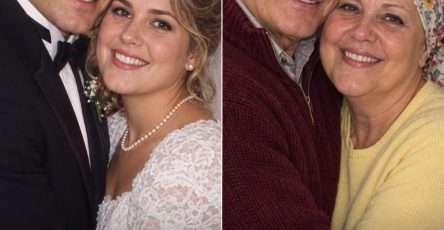


Lucy had every reason to walk away from my family.
Instead, she had been the one taking care of him.
The following morning, Maya called an emergency board meeting at our headquarters.
She walked into the room behaving as though she already controlled the company.
Then the doors opened.
I entered with my legal team, the forensic accountant, and investigators assigned to the case.
Maya stood.
“Alexander? What is going on?”
I placed a thick folder on the table.
“It’s over, Maya.”
Ryan immediately looked toward the exit, but investigators asked him to remain in the room.
Maya’s voice rose.
She accused me of betraying my own family.
For years, that word had been enough to control me.
Family.
But now I understood something.
Family cannot be used as permission to deceive people.
“You took money from the business,” I said calmly.
“You allowed Lucy to be blamed for transactions she didn’t authorize.”
Maya’s expression hardened.
“You misrepresented Dad’s care and accepted thousands of dollars every month for services he wasn’t receiving.”
“You can’t prove that.”
I opened the folder.
Then I placed a copy of Dad’s notebook on the table.
Her face changed instantly.
“Dad recorded the dates.”
I turned several pages.
“The truck numbers.”
Another page.
“The invoices.”
Then I looked toward Ryan.
“And Oscar is cooperating.”
Ryan lowered his head.
Maya looked around the boardroom as though she expected someone to defend her.
Nobody spoke.
Over the following months, investigators reconstructed years of financial misconduct.
They discovered fraudulent transactions, falsified corporate records, improper vendor arrangements, and serious irregularities involving Dad’s care.
Victor, the supplier whose photographs had once convinced me Lucy was having an affair, was also located.
He confirmed that the meeting with Lucy had been connected to concerns about Ryan’s behavior inside the company.
The photographs had been deliberately presented without context.
Maya and Ryan had created the deception.
But I stopped pretending that made me completely innocent.
Their story worked because I refused to listen.
Because I was jealous.
Because I believed being successful meant my instincts couldn’t be wrong.
Eventually, the legal case concluded.
Maya and Ryan were found responsible for multiple serious financial offenses and violations connected to Dad’s care.
They received lengthy prison sentences.
Oscar received a reduced penalty because he cooperated with investigators and returned the money he had received.
As Maya was escorted from the courtroom, she turned toward me with tears in her eyes.
“Alexander, please. I’m your sister.”
I didn’t answer.
Dad sat beside me in his wheelchair.
Months of intensive therapy had helped him regain limited movement in one arm, and his speech was slowly improving.
Lucy sat several rows behind us.
She had helped clear her own name.
She had protected my father.
And she had done both after I had refused to believe her when she needed me most.
I knew there was no apology that could magically repair what I had done.
No amount of money could return the years she had lost.
And proving her innocence did not automatically mean I deserved another chance.
For the first time, I understood that regret and forgiveness are not the same thing.
Sometimes being sorry means repairing whatever you still can.
Then respecting the other person’s decision about what happens next.
Lucy had told me clearly:
“Don’t confuse my help with forgiveness.”
I never did.
For years, I believed having money and running a successful business made me difficult to deceive.
Instead, my confidence had made me easier to manipulate.
I thought Lucy had betrayed me.
Ella no lo había hecho.
Pensé que Maya estaba protegiendo a la familia.
Ella no lo era.
Pensaba que Ryan era leal.
No lo era.
Pensaba que papá estaba recibiendo una atención excelente simplemente porque yo la estaba pagando.
No lo era.
Y cuando mi padre estaba en su momento más vulnerable, la persona que realmente permaneció a su lado fue la mujer a la que yo había apartado de mi vida.
Todavía recuerdo la tarde en que vi a Lucy recogiendo materiales reciclables bajo la lluvia.
No por lo que llevaba puesto.
No por los contenedores de basura.
Ni siquiera por el billete de cincuenta dólares que estaba tirado en el barro.
Lo recuerdo por lo que ella me contó.
“Algún día comprenderás lo mucho que te equivocaste al juzgar a la gente que te rodeaba.”
Ella tenía razón.
Esa comprensión se convirtió en una de las lecciones más difíciles de mi vida.
El dinero podría financiar la atención médica de papá.
Podría contratar abogados.
Podría reconstruir mi empresa.
Pero eso no podía borrar la forma en que había tratado a alguien que una vez confió en mí.
Esa parte era algo con lo que tenía que vivir.
Y a partir de ese día, lo único que pude controlar fue si me convertía en el tipo de persona que finalmente aprendía de ello.